Never to doubt that you will live to utter them
Black Water (Joyce Carol Oates Edition)“Never to doubt that you will live to utter them” is the expression of a survival faith Kelly Kelleher tries to make available to herself through the promise of future speech. It connects the act of rehearsing a story with the possibility of living through the event, but the contrast is severe: Kelly imagines an account in which she will tell friends how she was trapped and rescued, while the narrated accident shows her struggling in black water after The Senator flees the car. The phrase is therefore both a practical imaginative foothold and a fragile conviction tested by events.
Definition and Context
The expression appears in a sequence about preparing language for a future audience. Kelly shapes words that might later encapsulate her memory, perhaps for friends or for Carl Spader, who had known The Senator years earlier but was now distant from him. The narration insists on the importance of rehearsing that future in words: the story is not yet told, but Kelly’s capacity to tell it becomes something she must try to believe in advance.
The related formulations sharpen the idea without changing its central emphasis. The narration urges Kelly never to doubt that she will live to speak, and then recasts the assurance as never doubting that she will tell her story. Together, the phrases make survival and narration inseparable: the future speaker can exist only if there is a future in which she survives.
From Rehearsal to the Accident
The future account Kelly imagines is notably composed. She pictures describing the submerged car as a nightmare, explaining that water seeped in, that The Senator had gone for help, and that the car had fortunately retained air because its windows were shut and its air conditioner was running. In that prospective telling, the accident can be rendered as a horrible ordeal followed by rescue, even with a touch of retrospective wonder at having survived it.
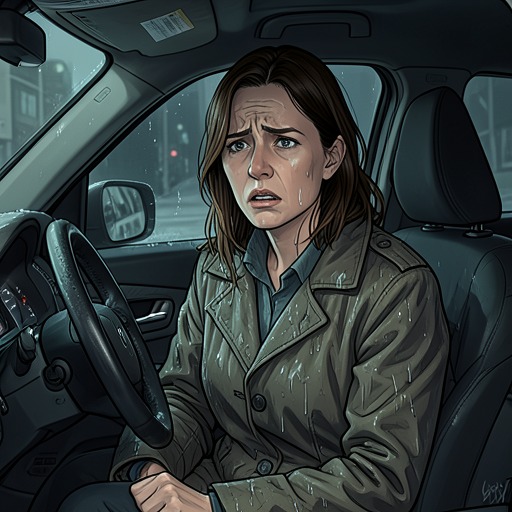
The accident itself is far less controlled. After The Senator brakes on the rutted road, the Toyota skids sideways, breaks through a guardrail, and plunges into water. The passenger door buckles inward as black, foaming water covers the car. Kelly cannot draw enough breath to scream or even call The Senator by name. The gap between the orderly story she rehearses and the immediate struggle for air gives the expression its force: it is a hoped-for account imposed against a scene in which speech and survival are both in doubt.
The Body Under Pressure
The phrase’s assurance is tested in specific bodily terms. As water rises around Kelly, she shivers in water that smells of sewage, gasoline, oil, and her own urine. She experiences the water as if it were something groping and fastening onto her, then recognizes that it is water. Her plea not to be left and her declaration that she is there occur inside a scene where the surroundings make the body feel both trapped and difficult to interpret.
She also remembers the abrupt reversal that brought her there: one moment she and The Senator were speeding along beneath the moon, his kiss hard on her mouth; the next, they were fighting for their lives. She understands that he kicked her in his terror as he tried to escape, and explains his action to herself as blind panic rather than deliberate cruelty. That understanding does not undo the abandonment or remove the danger. It shows how Kelly’s effort to make sense of what happened coexists with the physical emergency.
Desire, Vulnerability, and Agency
The expression’s focus on telling cannot be separated from the book’s attention to who acts upon Kelly’s body and whose desire is being registered. On the beach, as The Senator kisses, sucks, and gropes her while they remain fully clothed, Kelly feels the jolt not as her own desire but as the man’s. She recognizes a familiar anxiety and guilt: the fear that having made him want her means she will be unable to refuse him. The scene makes the difference between desire and obligation consequential rather than abstract.
Elsewhere, the narrative recalls a warm first rapport with The Senator and the brief, slightly over-hard pressure of his handshake. It also recalls how G----- sometimes hurt Kelly while making love, and how she pleaded for love while being physically overwhelmed. These moments place the accident’s bodily vulnerability within a wider pattern of touch, response, and power. They do not make Kelly’s reactions identical: the point is that her body can register another person’s force or desire before she can convert that experience into a settled account of her own.
The Limits and Stakes of the Promise
Kelly’s imagined future speech is not simply a confident report of what happened. It is a rehearsal that can rearrange the accident into a survivable narrative, including the claim that The Senator went for help. The scene in the car supplies a harder truth: she understands that he kicked her while escaping, and she is left fighting for breath. The discrepancy makes the anticipated story meaningful as an effort to continue, while also exposing the distance between a socially tellable account and the terror of the moment itself.
Even in extremity, Kelly bargains with the imagined rescue team. She offers her right leg, or both legs if necessary, promises to sign a release, and says she will not sue. She thinks of her father, Artie Kelleher, whom the family teases for being litigious, and tells herself she will explain the circumstances and take the blame. The bargaining gives her a limited form of agency: she cannot control the water or guarantee rescue, but she can imagine consenting to a cost that might keep her alive.
“Never to doubt that you will live to utter them” consequently holds hope and danger together. Its future tense asks Kelly to believe in a speaking self at the very point when breath, movement, and survival are threatened. The phrase does not establish that the imagined account is accurate or that hope can secure the outcome; it marks the act of rehearsing a future as one of the ways Kelly tries to remain oriented toward life.